Nontrivial Boundary-Mediated Superconducting Transport in a TRSB Topological Iron-Based Superconductor
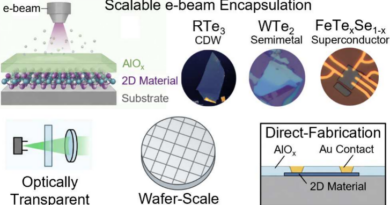
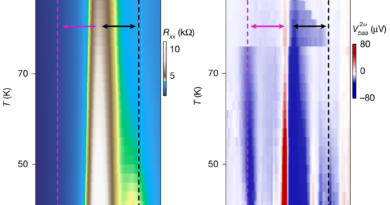
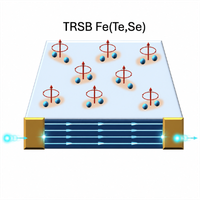
The interplay of superconductivity, band topology, and spontaneous time-reversal-symmetry breaking (TRSB) is expected to enable topological superconducting boundary states. Intriguingly, the iron-chalcogenide superconductor FeTe0.55Se0.45 exhibits spontaneous magnetization in the superconducting state, motivating its use as a single-material platform in which three ingredients coexist. Here, we report evidence for a nontrivial, boundary-mediated superconducting transport response in exfoliated Fe(Te,Se) devices, exhibiting long-range nonlocality and strongly suppressed thermal broadening. Polar Kerr measurements establish that TRSB emerges below TKerr < Tc and coexists with superconductivity across multiple Fe(Te,Se) compositions studied here, providing an independent symmetry-breaking scale that can be directly compared with transport. To reliably access boundary transport, we engineer crystallographically sharp, continuous edges and implement side-surface-dominant contacts, as validated by contact-size analysis and cross-sectional imaging. Under these conditions, topological FeTe0.55Se0.45 exhibits an anomalous conductance plateau that is absent in topologically trivial FeTe0.40Se0.60 and Fe1.02Te0.55Se0.45 under comparable measurements. This plateau requires both the source and drain to be attached to uninterrupted sharp edges, persists over micrometer-scale separations far exceeding the bulk coherence length, has markedly reduced thermal decoherence, and collapses when the drain is moved to the top surface. Its temperature evolution is governed by TRSB: The plateau shows minimal thermal broadening below T*Kerr and disappears near TKerr rather than Tc. Collectively, the doping selectivity, TRSB correlation, edge-geometry requirement, and long-range nonlocal nature establish experimentally grounded criteria for identifying boundary-mediated superconducting transport in FeTe0.55Se0.45 and motivate further phase-sensitive and theoretical work to determine its microscopic origin.