Scalable, Simple, and Versatile Encapsulation of 2D Materials and Devices
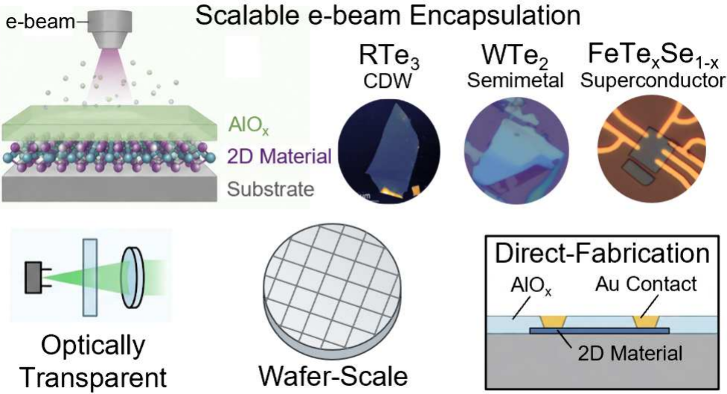
Air-sensitive 2D materials present fundamental challenges for device integration. Encapsulation is required to preserve intrinsic properties, yet conventional strategies demand complex fabrication workflows and fail for thicker flakes. We demonstrate that electron-beam (e-beam) evaporated aluminum oxide (AlOx) serves as an effective encapsulation layer and sacrificial fabrication mask, protecting sensitive flakes from air, photoresists, and chemicals. Unlike transfer-based approaches, this scalable technique requires no stacking and enables contacts without postencapsulation etching or harsh chemistry. Using rare-earth tritellurides (RTe3, R = La, Er), semimetallic WTe2, and superconducting FeTexSe1−x, we show that AlOx suppresses oxidation and preserves optical and electronic properties. We establish substrate-dependent encapsulation optimization across a range of flake thicknesses, show that ultrathin AlOx preserves WTe2’s plasmonic response, and enhance superconducting performance in FeTexSe1−x devices when used as a mask. Thus, we overcome the longstanding trade-off between encapsulation and straightforward device fabrication in fragile quantum materials.