Recent News

Hanqin Tian Receives the 2025 AGU Bert Bolin Award
Boston College Professor Hanqin Tian will receive the Bert Bolin Award and Lecture from the American Geophysical Union (AGU), recognizing his groundbreaking research and leadership in global environmental change.

Learn More →

Hanqin Tian leads the most comprehensive worldwide assessment to date of the potent greenhouse gas
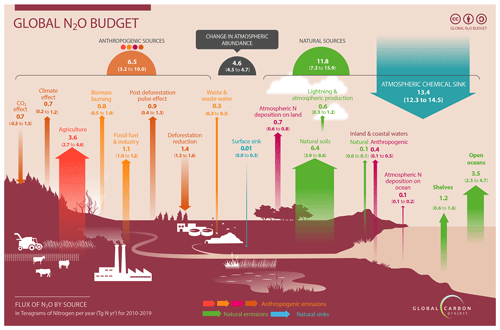
Food has a climate problem: Nitrous oxide emissions are accelerating with growing demand for fertilizer and meat – but there are solutions.

Learn More →

The Middle East’s First Comprehensive Carbon Budget

The RECCAP project examines the 24 countries in the Central and West Asia region, which encompasses the Middle East, because the region’s greenhouse gas emissions are underreported.

Learn More →

Working With DLEM

The Center for Earth System Science and Global Sustainability (CES3) and the Global Carbon Project (GCP) Boston Office at Boston College (BC) are seeking candidates for three postdoctoral positions (details provided below). The Center’s research supports key initiatives, including the GCP’s global assessments of nitrous oxide, methane, and carbon budgets, RECCAP3, Global Land Nitrogen Budget (N) – Model Intercomparison Project (NMIP), Land-Ocean-Aquatic Continuum (LOAC), the Global Stocktake, Carbon Dioxide Removal (CDR), Sustainable food systems, Nature-based Climate Solutions and Wildfire-GHG emissions. These positions offer a unique opportunity for early-career scientists to collaborate with leading experts from the Center and GCP scientific community. Most of the former students and postdocs have secured faculty positions and established their own research teams in the U.S. and other countries. For example, a recent postdoc was just offered a faculty position at Virginia Tech. Successful candidates will have access to state-of-the-art modeling tools, ground-based and satellite data, and advanced machine learning technologies. The start date is negotiable, with a preference for an immediate start.

To apply, please see additional details below and submit the following materials: 1) A cover letter outlined your research interest and qualification, 2) your CV, 3) DOI links to two representative publications, and 4) The names and contact information of three referees.

Postdoctoral Researcher – Terrestrial Biosphere Modeling with a focus on land use and wildfire dynamics

We are seeking a dedicated Postdoctoral Researcher to work on the Dynamic Land Ecosystem Model (DLEM), with a focus on land use/land cover (LULC) and wildfire dynamics. The successful candidate will improve model representations of LULC change, land management practices, and wildfire processes to better simulate coupled biogeochemical cycles and greenhouse gas fluxes in terrestrial ecosystems. This research contributes to ongoing GCP global assessments of carbon, methane, and nitrous oxide budgets, NMIP and TRENDY activities, the RECCAP3-National Initiative, Near-Real-Time GHG quantification (N₂O, CH₄, CO₂), wildfire-GHG emissions, nature-based solutions, and sustainable food systems.

Required Qualifications

  • Ph.D. in Ecosystem Ecology, Earth System Science, Geography and Geospatial Science, or a related field (within 5 years after degree completion).
  • Strong background in process-based ecosystem, biogeochemical, or land surface modeling.
  • In-depth understanding of global biogeochemical cycles (C, N, P) and greenhouse gas (GHG) budgets.
  • Experience with computer programming, preferably in C/C++.
  • Strong collaborative skills and effective scientific communication abilities.

Preferred Qualifications

  • Familiarity with remote sensing technologies and data assimilation methods.
  • Experience applying machine learning algorithms to environmental modeling.
  • Experience working in high-performance computing environments.
  • Knowledge of vegetation dynamics, land use/land cover change, and wildfire ecology.

Postdoctoral Researcher – GeoAI and Remote Sensing for water, food and ecosystems (MAP)

We are seeking a highly motivated Postdoctoral Researcher to advance the use of satellite Earth Observation (EO) data and GeoAI for Monitoring, Assessing and Predicting (MAP) the dynamics of water availability, agricultural productivity, and ecosystem health. The successful candidate will contribute to the development of predictive models and real-time monitoring systems to support early warning, water resource management, and sustainability policy.

This role sits at the intersection of environmental science, remote sensing, and artificial intelligence, and is embedded within a multidisciplinary team focused on applying cutting-edge technologies to pressing environmental and climate-related challenges.

Key Responsibilities

  • Monitor environmental and ecosystem changes using multi-source EO data (Sentinel, MODIS, Landsat, Planet) across water, agriculture, and ecosystem domains.
  • Develop GeoAI-driven models (e.g., CNNs, LSTMs, transformers) for forecasting drought, crop yield, land cover transitions, or ecosystem degradation.
  • Analyze temporal EO data to detect trends, anomalies, and early warning signals.
  • Combine satellite data with climate models, socio-economic data, and in-situ observations for integrated assessments.
  • Design and deploy automated, scalable pipelines for geospatial processing using cloud-based platforms (GEE, AWS, Microsoft Planetary Computer).
  • Publish high-impact scientific findings and present at major international conferences.
  • Contribute to collaborative grant proposals, data product development, and stakeholder engagement.

Key Required Qualifications

  • PhD (or near completion) in Remote Sensing, Earth System Science, Data Science, Geoinformatics, or a related field.
  • Expertise in processing and interpreting satellite EO data for environmental applications.
  • Strong programming skills in Python (preferred), R, MATLAB, or C++ with ML/AI package experience.
  • Familiarity with time-series analysis, forecasting techniques, and geospatial visualization.

Preferred Qualifications

  • Experience with deep learning models for spatiotemporal prediction.
  • Familiarity with environmental modeling (e.g., crop yield prediction, hydrological or watershed modeling).
  • Experience with cloud-based EO platforms (Earth Engine, Sentinel Hub, STAC, Open Data Cube).
  • Experience using HPC environments for large-scale EO data processing.

Postdoctoral Researcher – Integrated terrestrial-aquatic modeling for the lateral fluxes of sediment, nutrient and carbon

We are seeking a highly motivated and qualified Postdoctoral Researcher to advance the understanding and prediction of sediment transport, nutrient movement, and carbon dynamics along the land–ocean aquatic continuum (LOAC). Building upon previous work on lateral fluxes of water, nitrogen (N), phosphorus (P), carbon (C), and riverine GHGs, this project integrates process-based land surface, hydrological, and sediment transport modeling with machine learning approaches.

The goal is to develop an advanced Decision Support System (DSS) enabling data-driven solutions for sediment, nutrient, and carbon management, ultimately supporting watershed conservation strategies under current and future climate and land-use conditions.

Required Qualifications

  • Ph.D. in Earth and Environmental Science, Hydrology, Geography, Civil/Environmental Engineering, Computer Science, or a related field (within 5 years of degree completion).
  • Experience in process-based land surface, hydrological/watershed modeling, sediment transport modeling, or soil erosion studies.
  • Proficiency in programming (Python, MATLAB, or C++ preferred).
  • Experience with machine learning or GeoAI for environmental applications.
  • Experience with GIS, remote sensing, or spatiotemporal data processing.

Preferred Qualifications

  • Familiarity with LOAC systems or biogeochemical cycling across landscape–river–estuary interfaces.
  • Experience developing web-based dashboards or scientific visualization tools.

Ph.D. Recruitment – Fall 2026

We plan to recruit Ph.D. graduate students beginning in Fall 2026. Prospective students may come from a variety of educational backgrounds, but applicants with majors in Earth system science, ecosystem ecology, hydrology, meteorology, soil and crop science, forestry, geography, or related fields are preferred. Strong skills and a keen interest in computer programming, AI/Machine Learning, GIS, and remote sensing are highly desirable.

The dissertation research will generally align with the broad themes outlined in Dr. Hanqin Tian’s Faculty Profile, while providing flexibility for students to explore new research directions. To view recent publications, please visit Google Scholar.

Admission Requirements

  • Applicants whose native language is not English must provide evidence of English proficiency.
  • A minimum score of 100 on the TOEFL iBT or 7.0 on the IELTS is required.
  • The GRE is not required for admission.

Highly motivated students interested in applying to the Ph.D. program are encouraged to visit the Graduate Program page for the Department of Earth and Environmental Sciences (EES) at Boston College.

Scroll to Top