

Mengyu Gao Research Lab
Our research seeks to understand and control how electrons, ions, and matter interact at nanoscale interfaces, where many of the most important processes in energy conversion, electronics, and quantum materials emerge. We pioneer advanced synthesis, electron transport, microscopy, and device integration to discover materials that host molecular degree of freedom, with their dynamic energy and electron transport behaviors probed in situ. A central theme of the group is the development of molecularly programmable interfaces, where molecular structure, electrostatic environments, and nanoscale geometry are engineered to create new physical and chemical functionality. To accelerate discovery, we integrate higher-level automation and data-driven workflows that enable rapid synthesis, characterization, and analysis across a wide range of electronic and energy systems – from ion transport in battery materials to microscopic structural evolution in photovoltaics, from identifying catalytic active sites to interfacial charge transfer in novel transistors.
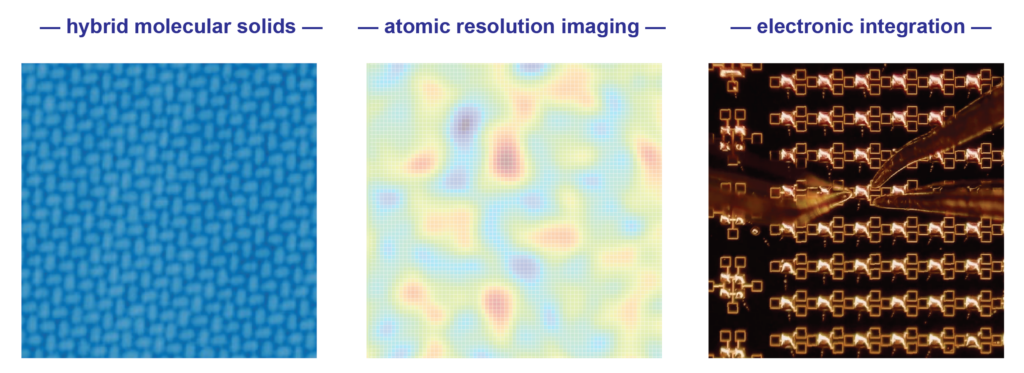
Hybrid Quantum Solids
We create two-dimensional synthetic hybrid materials with molecular-level precision and exciting quantum properties. Integrating organic species with an inorganic lattice through van der Waals interactions is a flexible strategy, as it offers a combinatorial and modular approach that leverages the vast libraries of both material classes. However, most of existing approaches cannot create hybrid materials with high structural order and electronic mobility that are critical for electronic and energy applications. We develop new synthetic tools, including colloidal synthesis, vapor-phase deposition, and solid-state synthesis, to explore new hybrid materials with high crystallinity, wafer-scale uniformity, and electronic mobility.
Advanced Imaging Platforms
We develop integrated experimental platforms that combine electron transport with microscopy and spectroscopy, enabling direct access to electronic, ionic, and energy dynamics across disparate length and time scales. By exploiting our materials as highly controllable electronic systems, we bring the full toolbox of condensed-matter physics (such as electron transport, Hall effect, cryogentic measurements, and microwave engineering) to address problems beyond the reach of conventional analytical techniques, in the meantime, optical probes add critical spatial resolution to these measurements.
Integrated Nanochemistry and Nanoelectronics
We combine molecular materials design with nanoscale devices for scalable fabrication, circuit integration, and electrically addressable chemical platforms. We are interested in how interfacial electrochemical and ionic processes can enable higher-level functionalities such as adaptive circuits, neuromorphic architectures, dynamic memory, and reconfigurable electronics. By connecting atomic-scale materials design with device-level and circuit-level behavior, we aim to establish new paradigms for information science and electronic systems.
Join us!
We are actively looking for motivated undergrads, graduate students, and postdoctoral scholars to join our group. If you are interested, feel free to send emails to Mengyu at mengyu.gao[at]bc.edu.
Students in our group receive interdisciplinary training in materials synthesis, advanced characterization (such as electron microscopy and scanning probe microscopy), electron transport measurements, and optics (including the development of home-built microscopy and spectroscopy tools). Our research combines both fundamental and applied perspectives, bridging chemistry, quantum physics, and micro-electronics.