

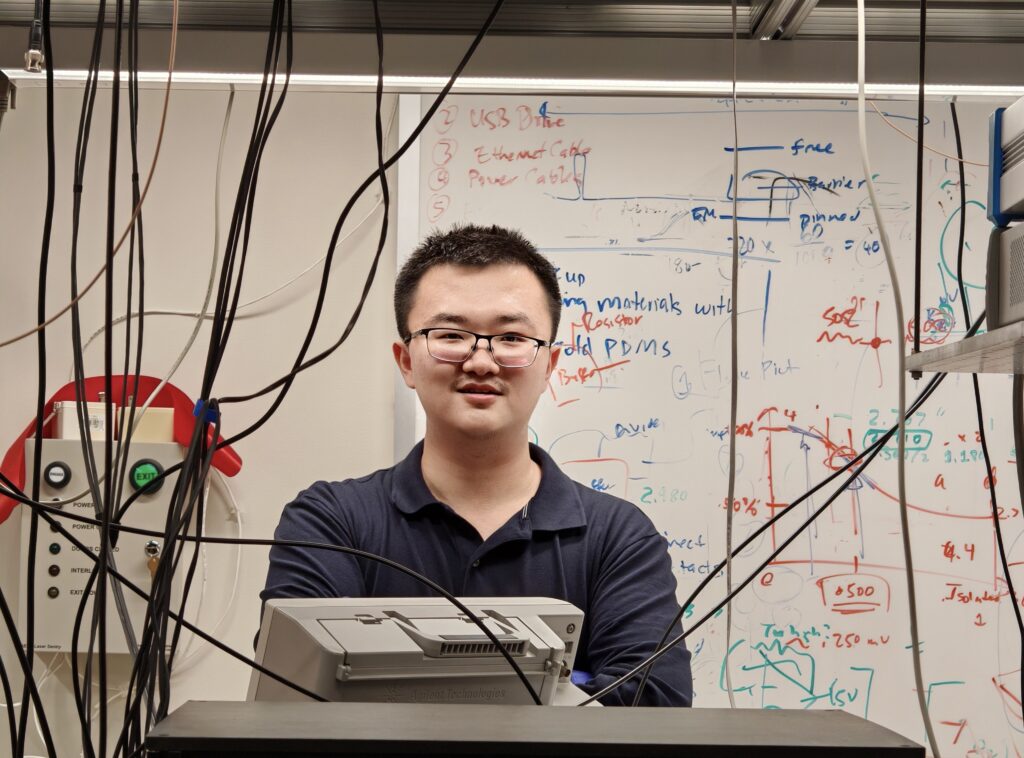
I grew up in Zhengzhou, Henan Province, China, and completed my undergraduate studies in physics at Shandong University. During my undergrads, I was introduced to experimental condensed matter physics by experience in Prof. Liang Wu’s lab. The opportunity to design, build, and troubleshoot instrument systems drew me toward a career in experimental physics, ultimately motivating me to pursue a PhD.
I became fascinated by the NV center in diamond as a powerful quantum sensor and a potential platform for quantum computing. After a conversation with Prof. Brian Zhou, I decided to join the Zhou Lab at Boston College, which might be the most important decision I’ve made in the past six years. During my PhD, I developed and applied NV-based quantum sensing platforms to study emergent phenomena in 2D materials, including antiferromagnetic domains and photocurrent flow. Brian’s lab gave me a great opportunity to get hands-on experience with cryogenic scanning probe microscopy, diamond and 2D material device fabrication, and automated data acquisition. I’ve also been lucky to work with amazing labmates, Xinyue and Thomas, who made this journey meaningful and a lot of fun.
Outside the lab, I enjoy reading, playing video games, coding and making figures (just for fun). When I’m not doing any of that, you’ll most likely find me catching up on sleep.
What brings you the most meaning or joy in your work today?
There are so many unforgettable moments that brought me happiness at Brian’s lab, like discovering the anisotropic photothermoelectric effect, finally getting something to work after days, or understanding my data a little bit better. I used to think the happiest moment would be getting a paper accepted. But looking back, it’s really the tiny daily progress that stand out: setting up an experiment, starting a scan before bed, and waking up excited to see a perfect map (although you might get something else accidently…). And when it comes to meaning, I just hope that someday someone from somewhere reads our paper and thinks, “Wait… this might help answer my question.”
Were there moments of self-doubt on your journey? How did you deal with them?
Absolutely many… Interestingly, I think they fall into two categories. The first is the ongoing realization of how little I know and how much there is still to learn (the so-called Dunning-Kruger effect). I’m still working on this one (I’ll let you know when I finally pass the local minimum). But I’ve learned that making a consistent effort to learn something new, staying curious, and being amazed by other people’s cool results and data has helped me keep going. The second kind of doubt comes from everyday experimental failures— things breaking, data not making sense, devices refusing to cooperate. For that, my solution is to get positive feedback from small progress, be happy when I make a good device or even write a good program. These small feedback, together with Brian’s “good work” encouragement, really helped me make it through these six years.
If you could tell your younger self one thing, what would it be?
This journey is not an easy path, but I can promise you that it is well worth it. Take every chance to better yourself, learn as many skills as possible along the way, and try the experiments again with more thoughts and patience. It will all work out, and you will be fine. Enjoy the journey.
Read more about Yuxuan’s research here and here.